Another round of diplomatic talks under the framework of the Working Mechanism for Consultation and Coordination is expected to be scheduled soon.
The two militaries are set to hold extensive talks on finalising modalities for restoring normalcy and bringing back peace and tranquillity in the region after the verification of the disengagement exercise is completed.

The visit is also aimed at boosting morale of the army personnel engaged in the seven-week bitter border faceoff with the Chinese troops in the region, sources added.
Sources said the process of disengagement along the Line of Actual Control is "complex", and in such a context, speculative and unsubstantiated reports need to be avoided.

The two sides held diplomatic talks through video conference on the border standoff in midst of fresh details emerging that China has strengthened its position in several areas in eastern Ladakh including Galwan Valley where a violent clash on June 15 left 20 Indian soldiers dead.

The Chief of the Army Staff interacted with almost all the injured soldiers and complimented them for their bravery.

Congress as the opposition party has become increasingly aggressive against the Narendra Modi government over its handling of the border standoff with China.

China said that after this incident both sides are in communication and coordination on the matter through diplomatic and military channels.
The intrusions into India were likely carried out by the PLA's better trained and equipped 'mobile operational units'.
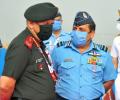
Gen Rawat's comments about the supporting role of the Air Force came at a conference when asked about the growing perception that the Indian Air Force was not keen on setting up the proposed theatre commands integrating the capabilities of the three forces.

'There is a point near the hill where you kill the engine and park your vehicle in neutral.' 'The vehicle automatically slides a few inches, which the locals believe is due to the magnetic power of the hill.'

'We should not allow ourselves to be surprised in any manner in future on the border.'

'(The) PM has surrendered Indian territory to Chinese aggression. If the land was Chinese: Why were our soldiers killed? Where were they killed,' he asked on Twitter, tagging the prime minister's remark.

'The Chinese thought India would back off. 'They did not expect such a firm Indian response to their expansionist manoeuvre.'
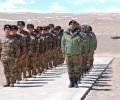
The sources said both sides held extensive deliberations on modalities for disengagement of troops from all the friction points in eastern Ladakh at the talks.
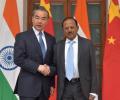
'Both sides had candid and in-depth discussions over easing the current border situation and reached positive common understandings,' it said. 'Both sides welcomed the progress achieved in the recent military and diplomatic meetings, agreed to stay in dialogue and consultation, and stressed the importance to promptly act on the consensus reached in the commander-level talks between Chinese and Indian border troops, and complete disengagement of the front-line troops as soon as possible,' it said.

The border guarding force is also moving its mechanised column assets like SUVs, all-terrain vehicles, snow scooters and trucks to forward locations in the midst of the projected increase in the number of troops at border units and fresh directives to undertake 'additional' patrols.
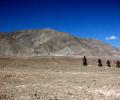
While the de-escalation process was underway, a violent face-off took place on Monday night between Indian and Chinese troops leading to the death of 20 Indian soldiers.
On May 5, around 250 Indian and Chinese army personnel clashed with iron rods, sticks, and even resorted to stone-pelting in Pangong Tso lake area in Eastern Ladakh.

'We would have faced many more Galwans had Indian troops not reacted and retaliated the way they did.'

China remains in firm control of an estimated 600-800 square kilometres of Indian territory.
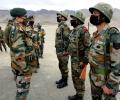
'India is not the India of 1962. We are not carrying that baggage of history anymore.'
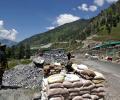
The meeting was attended by National Security Advisor Ajit Doval, Chief of Defence Staff General Bipin Rawat, Army Chief General M M Naravane, Navy Chief Admiral Karambir Singh and Indian Air Force Chief Air Chief Marshal R K S Bhadauria.

The Chinese military is now desperately attempting to give "ex post facto strategic meaning" to its actions in eastern Ladakh.
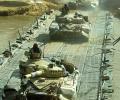
DRDO plans to build a tank for use in the mountains and in the jungles.

Addressing the Congress Working Committee, the president of the party said, ""Misfortunes do not come singly. India has been hit by a terrible economic crisis, a pandemic of huge proportions and, now, by a full-blown crisis on the borders with China. Much of each crisis is attributable to the mismanagement of the BJP-led National Democratic Alliance government and the wrong policies pursued by it."

'Why wouldn't so strategically-minded an adversary, such as China, not militarily exploit to the maximum Indian timidity, stupidity, and cupidity all along the LAC and legitimate, as it has done so often in the past, the fait accompli of incremental territorial grabs which, by the way, is its strategy and policy as implemented on the ground?'

Gen Naravane said that the Indian Army did not hide casualties during Galwan clash in eastern Ladakh as the Chinse have done.

Singh said if there is an attempt to hurt the self-respect of India, then it will not be tolerated and will be given a 'befitting reply'. "Whatever progress has been made in the talks, there should be a resolution of the matter. But to what extent it will be resolved, I cannot guarantee."
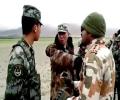
Over the last few weeks, bipartisan support for India against China has been increasing.
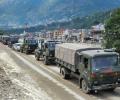
Indian Army planners find themselves contemplating the possibility of more Chinese intrusions along the contested 3,488-km border. That could lead to the army having to man a 'hardened LAC' round the year, like the LoC with Pakistan, reports Ajai Shukla.

The Indian and Chinese armies have been locked in a bitter standoff at multiple locations in eastern Ladakh for over eight weeks since May 5.

Both sides have completed creation of a buffer zone of three kilometres in the three friction points of Galwan Valley, Gogra and Hot Springs as part of a temporary measure aimed at reducing the possibility of any confrontation.

The talks took place over video call on Sunday. According to sources, talks were held for over two hours in a cordial and forward-looking manner.
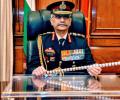
Nepal raised objection to India's newly-inaugurated road linking Lipulekh Pass with Dharchula in Uttarakhand.

China has chosen to keep New Delhi guessing, while retaining for itself the option of constantly changing facts on the ground and shifting the LAC westwards -- the strategy called 'salami slicing', notes Ajai Shukla.

Indian Army chief General Manoj Mukund Naravane on Tuesday said that as far as the western front was concerned, there is an increase in the concentration of terrorists in various launch pads and there have been repeated attempts of infiltration across the Line of Control.
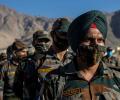
Did Xi deliver a message to Modi at Mamallapuram, which though couched in a velvet glove was time-bound? What was that message? It is clear Indian/Israeli/US spy satellites would not have missed detecting Chinese troop movements towards the Ladakh-Tibet frontier. Then why did some important functionaries in the Government of India choose to only ask the Russians about this in April 2020? Was Russian reassurance of Chinese troop movements being part of a routine exercise the reason that the Leh-based XIV Corps did not mobilise itself for its annual summer exercises near the LAC? A fascinating excerpt from Iqbal Chand Malhotra's new book Red Fear: The China Threat.

India must break out of this strategic triangulation between China and Pakistan. We need to settle our issues with one of the two, notes Shekhar Gupta.

'If our troops on the frontlines were sleeping for two hours, they can perhaps now sleep for 2.5 hours because when the adversary is right in front, then you can't even blink your eyes, you have to be absolutely alert.'
